

Last updated: 28 September 2026
Trading is a major part of Blox Fruits, especially when you are trying to get high-value fruits such as Dragon, Kitsune, Control, Tiger, or Yeti. Unlike Beli and Robux prices, trade values are based on the player market, so they can change with demand, updates, and new fruit reworks. This guide covers current values of fruits in Blox Fruits, how to trade them, and more.

Blox Fruits Values: Quick Overview
- Value Type: Community trading value
- Main Trading Items: Physical fruits, permanent fruits, gamepasses, and limited items
- Highest Physical Fruit Values: Dragon and Kitsune are currently among the highest
- Highest Demand: Kitsune, Portal, and Buddha have 10/10 demand on the current tracker
- Permanent Fruits: Have a separate trade value from physical fruits
- Trading Location: Café in the Second Sea and Mansion in the Third Sea
- Second Sea Requirement: Level 700+
- Value Changes: Can change with demand, updates, and reworks
- Important: Value is not the same as the fruit’s Beli price
Blox Fruits Values List
The table shows Blox Fruits values, including trade values, demand ratings, and Beli prices for popular fruits like West Dragon, East Dragon, Kitsune, and Control.
| Fruit | Rarity | Trade Value | Demand | Beli Price |
| West Dragon | Mythical | 3.63B | 10/10 | 15M |
| East Dragon | Mythical | 3.06B | 10/10 | 15M |
| Kitsune | Mythical | 600M | 10/10 | 8M |
| Control | Mythical | 150M | 8/10 | 9M |
| Tiger | Mythical | 120M | 8/10 | 5M |
| Yeti | Mythical | 110M | 7/10 | 5M |
| Gas | Mythical | 60M | 8/10 | 3.2M |
| Dough | Mythical | 30M | 9/10 | 2.8M |
| Venom | Mythical | 20M | 7/10 | 3M |
| T-Rex | Mythical | 20M | 8/10 | 2.7M |
| Gravity | Mythical | 10M | 5/10 | 2.5M |
| Mammoth | Mythical | 10M | 5/10 | 2.7M |
| Spirit | Mythical | 10M | 7/10 | 3.4M |
| Shadow | Mythical | 6.5M | 5/10 | 2.9M |
| Lightning | Legendary | 35M | 6/10 | 2.1M |
| Pain | Legendary | 10M | 5/10 | 2.3M |
| Portal | Legendary | 10M | 10/10 | 1.9M |
| Buddha | Legendary | 10M | 10/10 | 1.2M |
| Blizzard | Legendary | 5M | 5/10 | 2.4M |
| Phoenix | Legendary | 2.75M | 3/10 | 1.8M |
| Creation | Legendary | 2.5M | 2/10 | 1.4M |
| Sound | Legendary | 2.5M | 4/10 | 1.7M |
| Spider | Legendary | 1.5M | 2/10 | 1.5M |
| Love | Legendary | 1.5M | 3/10 | 1.3M |
| Quake | Legendary | 1M | 2/10 | 1M |
| Magma | Rare | 1.15M | 5/10 | 960K |
| Light | Rare | 800K | 2/10 | 650K |
| Ghost | Rare | 800K | 1/10 | 940K |
| Rubber | Rare | 700K | 1/10 | 750K |
| Diamond | Uncommon | 1M | 2/10 | 600K |
| Eagle | Uncommon | 800K | 2/10 | 550K |
| Ice | Uncommon | 550K | 2/10 | 350K |
| Sand | Uncommon | 420K | 1/10 | 420K |
| Dark | Uncommon | 400K | 1/10 | 500K |
| Flame | Uncommon | 250K | 1/10 | 250K |
| Spike | Common | 180K | 1/10 | 180K |
| Smoke | Common | 100K | 1/10 | 100K |
| Bomb | Common | 80K | 1/10 | 80K |
| Spring | Common | 60K | 1/10 | 60K |
| Blade | Common | 50K | 1/10 | 30K |
| Spin | Common | 7.5K | 1/10 | 7.5K |
| Rocket | Common | 5K | 1/10 | 5K |
What Does Blox Fruits Value Mean?
A Blox Fruit trading value is a relative number used by the community to compare items. It is not the amount of Beli you receive for selling a fruit. For example, the current tracker lists Kitsune at 600M trade value and an 8M Beli Dealer price. The 600M figure does not mean Kitsune can be sold for 600M Beli. Because these Blox Fruit values are based on the trading market, they can move when demand changes or when the game receives an update or rework.
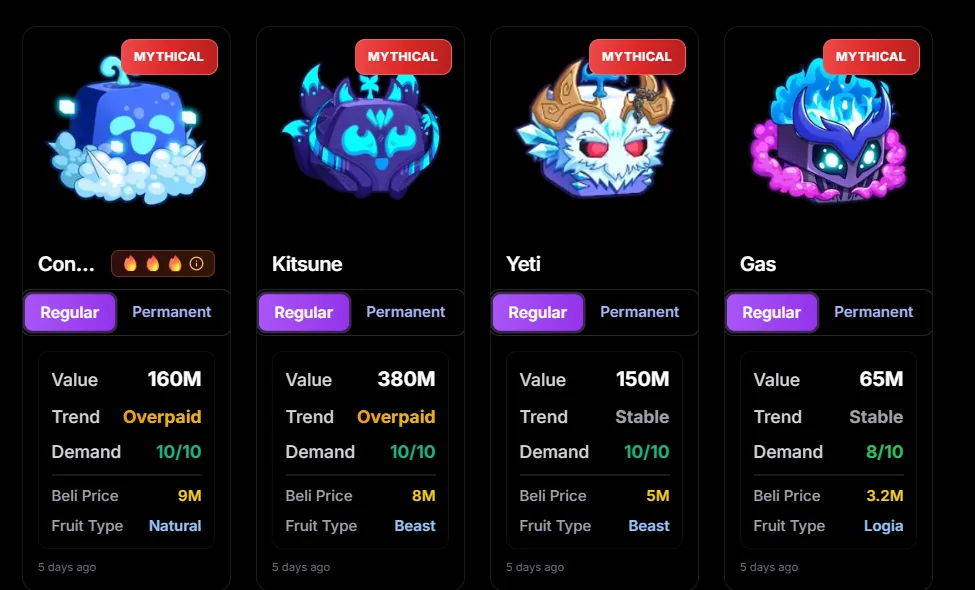
Trade Value vs Beli Price
These two numbers are easy to confuse.
| Term | Meaning |
| Trade Value | Community estimate used to compare trades |
| Beli Price | Price from the Blox Fruit Dealer |
| Robux Price | Price when buying a fruit with Robux |
| Demand | How strongly players currently want the fruit |
A fruit can have a high Beli price but a lower trading value, or the other way around. The two numbers measure different things.
Physical vs Permanent Fruit Values
Physical and permanent fruits are different trade items. A physical fruit is the regular fruit you can hold and trade. A permanent fruit is purchased for Robux and remains available on your account after you use it. Community trackers assign separate values to these two versions.
| Type | What It Means |
| Physical Fruit | Regular fruit that can be stored and traded |
| Permanent Fruit | Robux fruit that stays unlocked on your account |
| Physical Value | Community value for the regular fruit |
| Permanent Value | Separate market value for the permanent version |
Do not assume that a permanent fruit is simply worth a fixed multiple of the physical version. Permanent trading values can move independently based on demand.
How to Trade in Blox Fruits?
Trading for Blox Fruits takes place at dedicated trading tables. In the Second Sea, players can trade at the Café in the Kingdom of Rose. The Café has two trading tables and is the only trading location in the Second Sea. Players can also trade in the Mansion in the Third Sea.
To make a trade:
- Reach the Second Sea.
- Go to the Café or use the Mansion in the Third Sea.
- Sit at a trading table.
- Select the player you want to trade with.
- Add your items.
- Check the other player’s offer.
- Compare the trade values.
- Confirm the trade only after checking everything.
The Second Sea requires Level 700 and completion of the required access quest.
How to Check if a Blox Fruits Trade Is Fair
Never look at just one fruit in Blox Fruits. Check the total Blox Fruit value on both sides and then look at demand. A trade can have similar numerical values but still be difficult to complete later if the items on your side have much lower demand. For example, the current tracker gives Kitsune a 10/10 demand rating, while several lower-value fruits have demand scores of only 1/10 or 2/10.
A simple way to check a trade is:
- Add the value of every item you are giving.
- Add the value of every item you are receiving.
- Compare the totals.
- Check demand.
- Check whether the fruits are physical or permanent.
- Confirm the exact items in the in-game trade window.
High-Demand Blox Fruits
Some fruits are especially useful when trading because many players actively look for them.
| Fruit | Current Value | Demand |
| Kitsune | 600M | 10/10 |
| Dough | 30M | 9/10 |
| Buddha | 10M | 10/10 |
| Portal | 10M | 10/10 |
| Control | 150M | 8/10 |
| Gas | 60M | 8/10 |
| Tiger | 120M | 8/10 |
| Yeti | 110M | 7/10 |
| Venom | 20M | 7/10 |
| T-Rex | 20M | 8/10 |
Current Blox Fruit values and demand ratings can change, so this table should be treated as a market snapshot rather than a permanent ranking.

Best Fruits to Keep for Trading
Some fruits are worth keeping even when you are not planning to use them yourself. Dragon, Kitsune, Control, Tiger, Yeti, Gas, and Dough currently have much higher community values than most fruits in the list. Buddha and Portal also have strong demand despite their lower numerical value. The main thing to remember is that trade value and usefulness are not the same thing. A fruit can be valuable because of demand even if you do not personally want to use it.

Related Guides

Blox Fruits Values & Trading: FAQs
Q. What is the most valuable fruit in Blox Fruits?
A. In the current September 25, 2026 community snapshot, West Dragon has the highest listed physical trade value at 3.63B, followed by East Dragon at 3.06B.
Q. What is the best fruit to trade for?
A. High-demand fruits such as Kitsune, Dragon, Buddha, Portal, Dough, and Control are actively tracked by the community market. The right fruit to trade depends on the value and demand of the offer you receive.
Q. What does WFL mean in Blox Fruits trading?
A. WFL means Win, Fair, Lose. It is commonly used by players and trade calculators to describe whether an offer gives one side more or less value.
Q. What is a fair trade in Blox Fruits?
A. A fair trade generally has similar total market values on both sides, but demand and the type of items being traded also matter.
Q. Where can you trade in Blox Fruits?
A. You can trade at the Café in the Second Sea and the Mansion in the Third Sea.
Q. What level do you need to trade in Blox Fruits?
A. You need access to the Second Sea, which requires Level 700 and completion of the required quest.
Q. Is Blox Fruits trade value the same as Beli price?
A. No. Beli price is the amount charged by the Blox Fruit Dealer, while trade value is a community estimate used to compare player offers.
Q. How many fruits are currently tracked in the value list?
A. The current tracker shows 42 tradeable fruit entries, including separate West Dragon and East Dragon entries.


